Original speaker cables + additional cables (TW, rear, no door wiring)
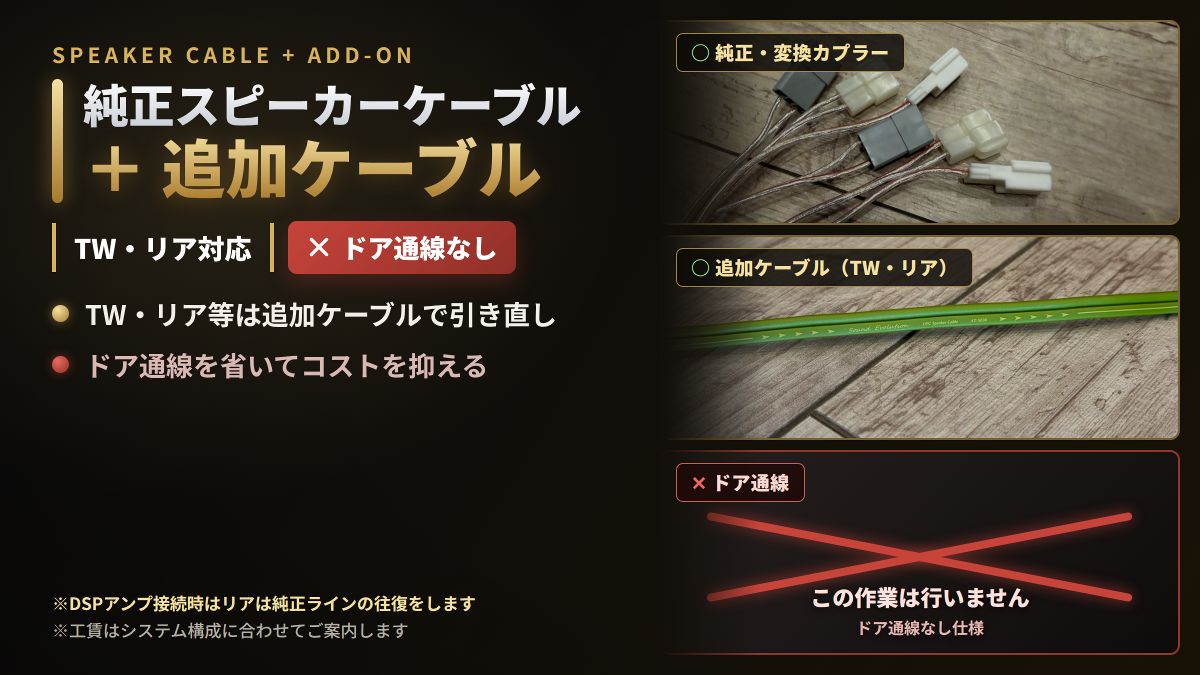
Since most genuine products these days have aluminum wiring, you can easily and reliably install them using a conversion coupler!
【Genuine Speaker Cable + Additional Cable (TW / Rear / No Door Pass-Through Wiring) Specification|LOGON Original Installation that Organizes the Sound While Preserving Genuine Wiring with Vehicle-Specific Harness Included】
I want to improve the sound by replacing speakers or installing a DSP amplifier.
But I’d like to avoid, as much as possible, an installation that unnecessarily cuts the factory wiring or places extra burden on the vehicle.
For people like that, this LOGON original installation specification is the Genuine Speaker Cable + Additional Cable (TW / Rear / No Door Pass-Through Wiring) Specification.
With this specification, while making use of the vehicle-side factory speaker wiring, we combine additional cables in the necessary areas to accommodate speaker replacement and DSP amplifier installation.
Furthermore, because a vehicle-specific harness is included, the compatible sections can be connected using couplers, making it easier to perform an installation that minimizes modifications to the factory wiring.
In recent cars, the way wiring is approached has changed quite a lot compared with older vehicles.
For weight reduction and efficiency, some vehicles use aluminum-type wiring. If you casually modify the factory speaker wiring, it may lead to future problems such as poor contact, oxidation, or corrosion.
Because these are places where issues don’t necessarily appear right away, LOGON takes special care of such “invisible” parts.
In today’s car audio, it’s quite important to install not only for better sound, but also with reliability on the vehicle side and future serviceability in mind.
An Installation Specification that Leverages Factory Wiring and Adds Only What’s Needed
This specification is not based on the idea of re-routing all speaker cables from scratch.
We use the parts where the factory speaker cables can be utilized, and, depending on the system configuration—such as tweeters and rear speakers—we organize everything together by using additional cables for the necessary locations.
The key point is that this is a specification that does not perform new pass-through wiring inside the door.
Door pass-through wiring varies greatly in workability and risk depending on the vehicle model.
In many recent cars, the door couplers and the structure of the factory harness are complex, so it isn’t as simple as “just make the cable thicker” or “just re-run everything.”
With this specification, rather than forcing new wiring through the interior of the door, we aim for a realistic and service-friendly approach by combining the factory wiring with additional cables.
It isn’t flashy, but because it’s the kind of part that’s hard to review later, it’s something we should think through properly from the start.
Important as the Foundation for Speaker Replacement and DSP Amplifier Installation
Car audio isn’t determined only by the speakers or the DSP amplifier unit itself.
Where you take the signal from, how you connect it, and which parts you keep as-is from the factory all matter.
Your thinking in these areas affects the final result and ease of use.
In recent cars, speakers may be involved not only in music playback, but also with navigation audio, vehicle notification sounds, system sounds, and more.
Therefore, if you change the wiring significantly without considering how it relates to the factory system, even if you get sound, you may feel something is off in terms of usability.
If it were me, the more recent the car, the more carefully I would handle the wiring parts you can’t easily see.
Of course I want it to sound good, but because it’s a car you’ll drive every day, I want it to be straightforward to use and difficult to regret later.
Recommended for People Like This
The Genuine Speaker Cable + Additional Cable (TW / Rear / No Door Pass-Through Wiring) Specification is suited for people such as:
- Those considering speaker replacement and/or DSP amplifier installation
- Those who want to minimize modifications to the factory speaker wiring
- Those who want to connect as naturally as possible using a vehicle-specific harness
- Those who want to tune the sound with a realistic configuration without doing new pass-through wiring inside the door
- Those who want to balance sound quality improvement with peace of mind for the vehicle side
- Those who want the installation done while keeping future service and system upgrades in mind
- Those who also care about the finishing of parts that aren’t easily seen
At LOGON, we don’t think of audio installation as “finished once the sound comes out.”
We’ll consider everything together—from the vehicle model, the factory audio configuration, the speakers and DSP amplifier to be installed, and even future expandability—so we can find a practical approach.
This specification isn’t a part that stands out after installation.
But it is the foundation for speaker replacement and DSP amplifier installation.
To enjoy your important vehicle for a long time, let’s create a good outcome not only in terms of sound finishing, but also in how the wiring is handled.