Sound readjustment (PC adjustment of DSP installed by our shop)
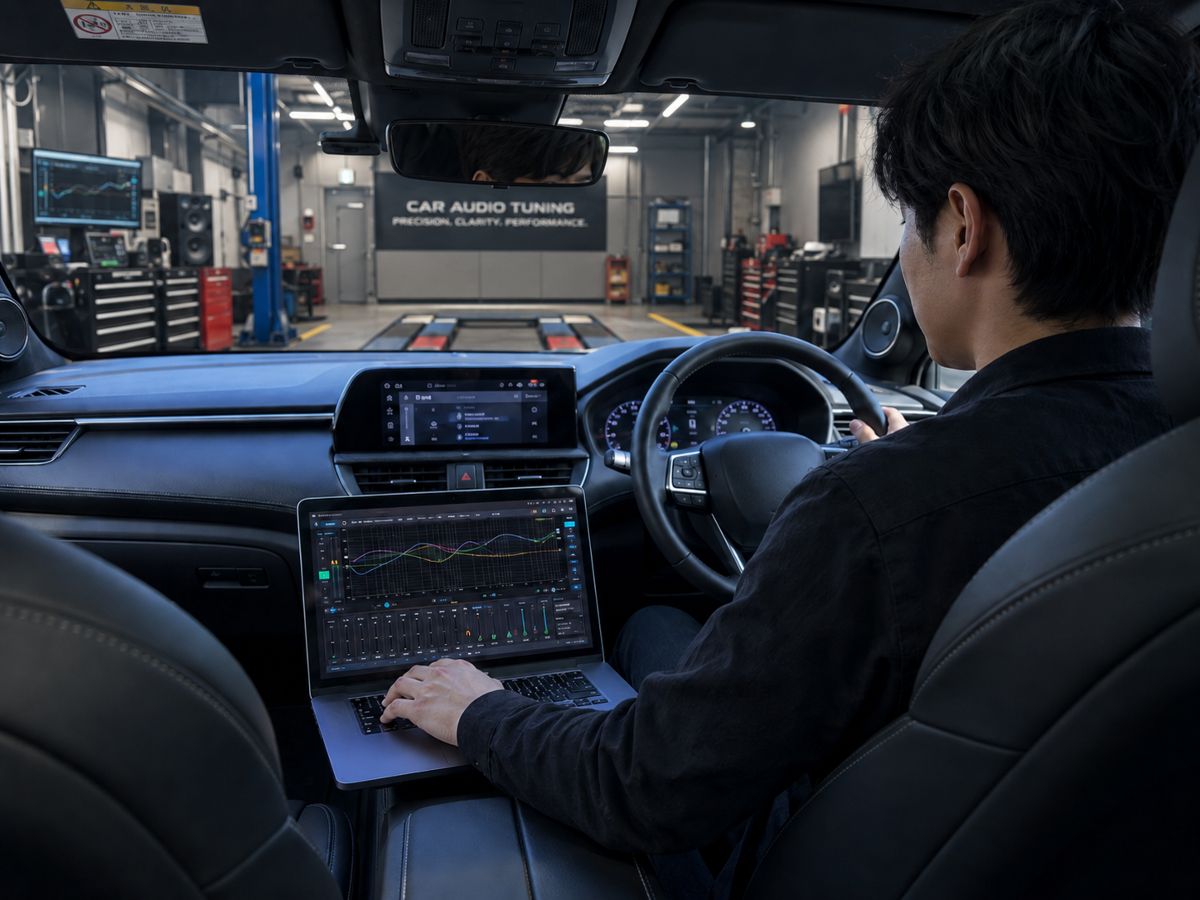
Review your usual sound and make your drive even more comfortable.
【Re-tuning the Sound of a Car Audio System|Re-Setup to Make Use of DSPs and Speakers Installed by Other Shops】
Even though you’ve had a car audio system installed, you may be experiencing:
- Vocals feel too far away
- The soundstage doesn’t feel cohesive
- Only the bass sounds strong
- It becomes tiring when you turn the volume up
- You installed a DSP, but the sound isn’t what you expected
- It feels like you’re not making full use of the speakers and amplifier you paid for
In such cases, before immediately replacing the equipment, it’s worth reviewing your current system once.
At Logon, we accept consultations for re-tuning when a car audio system was installed by another shop.
We’ll check the DSP, speakers, amplifier, etc. that are currently installed, and, while listening to how it sounds inside the vehicle, determine whether there are aspects that can be improved through adjustment.
First, confirm your current system
Car audio isn’t determined by equipment performance alone.
Various factors overlap to produce the final sound, such as the mounting condition of the speakers, door-side treatments, combinations of the equipment, how it’s connected to the factory system, and the DSP settings.
Even with the same speakers or DSP, if the settings or installation conditions change, impressions can also change—vocal positioning, the connection of the bass, the perceived “thickness” of the sound, and how easy it is to listen to when the volume is raised.
That’s why we don’t simply assume by email alone that “it will be fixed if we adjust it.”
First, we’ll check the actual vehicle and the current system to identify how much can be addressed through adjustments. This is the part we want to confirm accurately so that nothing changes later.
Even if it was installed by another shop, there may be a chance to make the existing equipment work
Just because a system was installed by another shop doesn’t necessarily mean you need to redo everything right away.
Revisiting settings may bring the sound balance into alignment. And in some cases, rather than only adjusting the DSP, you may need to check other areas as well—such as the connection conditions or how the speakers are mounted.
Before making adjustments, after confirming the current state, we’ll break down:
- Parts that seem likely to be improved through adjustment
- Parts that require reviewing the installation work
- If you plan to make changes in the future, which parts you should prioritize
- Parts that, for now, may be better not to change forcefully
Tune the sound to match how you listen to music
Sound preferences differ from customer to customer.
Some people want vocals to feel closer, while others prioritize the spread of the instruments or the thickness of the bass. Even the right type of adjustment changes depending on the music you usually listen to, the volume level while driving, and whether you often listen for long periods.
At Logon, we don’t focus only on matching numbers—we care about how it feels when you actually listen to music inside the car.
Together, we look for the direction where you can notice differences in your everyday use, such as:
“Vocals in the songs I always listen to sound more natural.”
“The bass is no longer the only thing that stands out.”
“Even when I turn the volume up, I don’t get as tired of listening.”
If adjustment alone is difficult, we’ll be honest about it
When the cause is something like the speaker mounting condition, door treatment, wiring/connections, or the combination of equipment, simply re-tuning the DSP may not produce a major change.
In that case, we won’t push ahead with adjustment work just to do it—we’ll confirm whether there are necessary areas that need to be reviewed.
- “Proceed with adjustment only”
- “First, review the mounting condition”
- “Use it for a while in its current state”
- “In the future, change some equipment or installation work”
Which approach is best depends on the vehicle condition, your budget, and your sound preferences. We’ll explain honestly not only what we can do, but also parts where changes may be difficult even if you spend money.
For those who are having trouble with a car audio system installed by another shop
There’s no reason you shouldn’t be able to consult just because it was installed by another shop.
The important thing is not to deny the current system, but to confirm what kind of sound you want to achieve in your car—and how close you can realistically get given the current condition.
In the case of re-tuning when the system was installed by another shop, after confirming the actual vehicle and the system configuration, we’ll guide you on the adjustment plan and how to proceed going forward.
Before considering a replacement of the equipment, why not check your current sound together first? Since it’s a car audio system that you had installed, let’s aim for a way you can feel satisfied with and enjoy as much as possible.