M-SIX
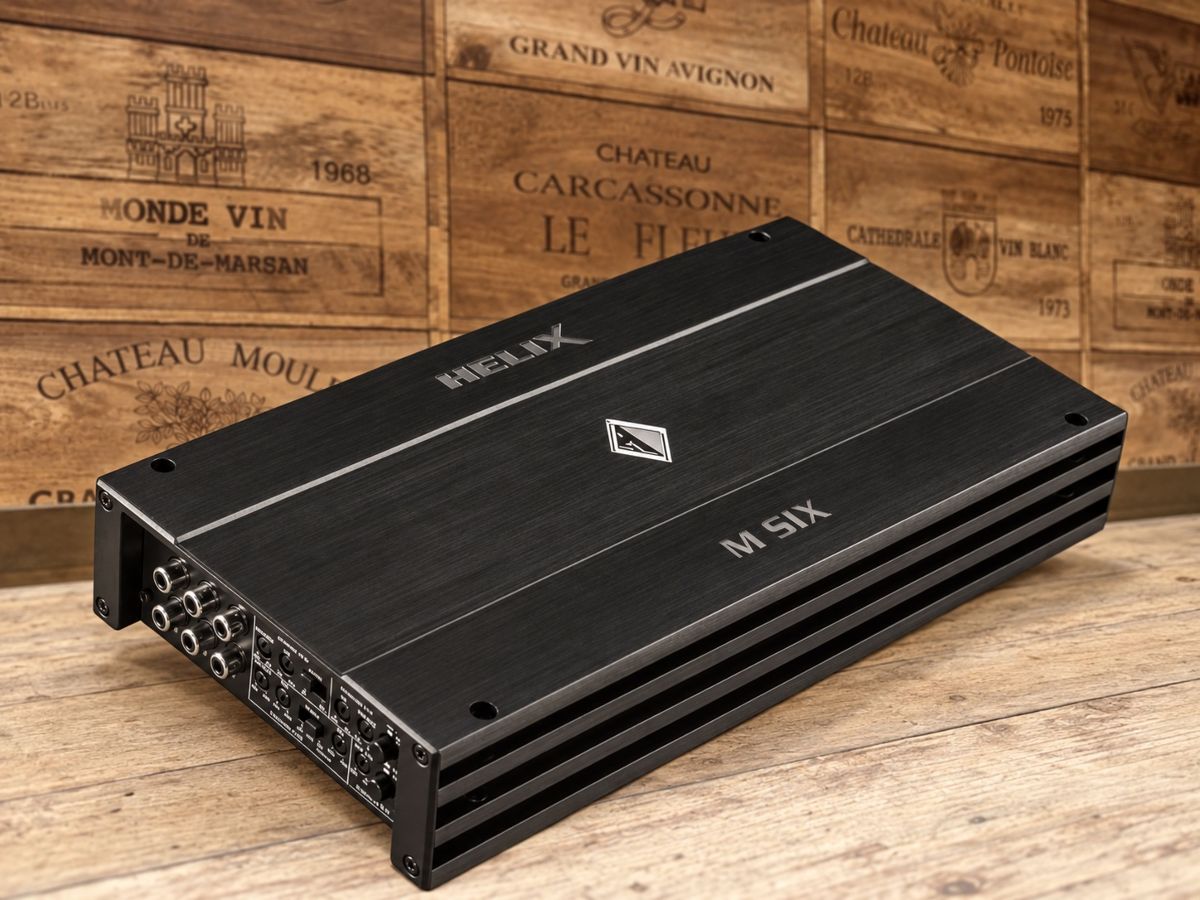
The driving force of the M-SIX that brings out the expression of a familiar track.
【M-SIX|High-Power Class D Power Amplifier Built Compactly】
You’d like your car audio to sound a bit more solid, but adding an amplifier makes you worry about the installation space. M-SIX is the option we’d like you to consider—featuring a high-output Class D circuit in a compact body.
The design combines two parallel D-class amplifier sections using MOS-FETs, enabling powerful drive for your speakers. In addition, the power supply section also uses MOS-FETs in a three-parallel configuration, ensuring a stable power supply even within limited dimensions.
A built-in crossover is another handy feature. The high-pass can be set in the range of 15 Hz to 4 kHz, and the low-pass can be set from 40 Hz to 4 kHz. It supports not only a high-pass for speakers and a low-pass for a subwoofer, but also a band-pass. It’s an amplifier that’s easy to use even for speaker-by-speaker role-splitting system configurations, such as a 2-way multi system.
It also lets you switch between stereo mode and summing mode, so you can consider how to set up the system according to your configuration and input method. This model isn’t just about adding another amplifier—it changes how you can take advantage of it depending on how you want to develop your current system.
The final sound depends not only on the amplifier’s performance, but also on how you take power, how you handle wiring, the installation method, the way you pair it with your speakers, and your crossover settings. If I were doing it, I’d check your current system and the sound you want to aim for before installing the M-SIX, and then build the setup including which speakers to drive and how.
If you want “a bit more punch from the factory system,” “to play speakers with multi-wiring,” or “to organize your system with a compact amplifier,” let’s decide the direction together while looking at your vehicle model and current configuration.
Main Specifications / Specs
【Basic Information】
- Product name: M-SIX
- Type: Class D power amplifier
- Operating method: Class D
- Amplification circuit: MOS-FET, 2-parallel configuration
- Power supply section: MOS-FET, 3-parallel configuration
【Crossover】
- High-pass: 15 Hz to 4 kHz
- Low-pass: 40 Hz to 4 kHz
- Band-pass: Supported
- Usage examples: 3ch / 4ch / 5ch / 6ch
- 2-way multi system: Supported
【Mode Switching】
- Stereo mode: Supported
- Summing mode: Supported
Specifications such as output values, dimensions, and weight are listed only for information that could be confirmed.